
Where you start
Three doors. One seat.
Different lives produce different evidence, so the process starts differently for each. Pick the strongest true claim about yours. We check the evidence, not the label.
Track A
I have worked
Startup experience, or a real hand in your family's business.
This is you if
- You were employed at a startup or a small company, and can show it (offer letter or experience certificate)
- Or your family runs a business (a factory, a shop, a distributorship, a farm) and you carried real responsibility in it: customers, vendors, stock, staff, or money
- The bar is proven cross-functional accountability: you were answerable for outcomes that cut across functions (purchases, payments, customers, staff, stock), and the 10 questions ask you to prove it, one real event at a time
Track B
I have led
A college club, a fest, an E-Cell, with your name on the outcome.
This is you if
- You held the position: president, secretary, lead, or coordinator of a club, fest, E-Cell, NSS/NCC unit, or sports team
- You made calls others followed: budgets, vendors, teams, deadlines
- One thing proves you belong here: accountability that crossed teams. Not "I handled sponsorship", but times the sponsorship, the event team, the money, and the faculty all had to line up, and you were the one answerable. That is what the 10 questions probe
Track C
I am starting
Everyone starts somewhere. This door judges only the work.
This is you if
- Track A and B don't fit yet: you are in final year, freshly graduated, or between things
- Here the assignment is the entire application: no CV, no percentage cutoff, no college-name filter
- You bring 48 focused hours and your own thinking on paper
Not sure which door is yours? Pick the strongest true claim. If you pick wrong, we re-route you, we don't reject you.
Job Description
The job, on one card.
You sit inside a running pharmaceutical factory and build the operating system of its execution: how work gets planned, tracked, escalated, and closed. There is no manager in between. You work with the CEO directly, with DeepThought's method behind you.
Role
AI Business Analyst - Process Management
Location
Atchutapuram (AP) or Hyderabad, your choice
Schedule
9:30 AM – 6:00 PM · Monday – Saturday
Duration
24 months
Compensation
Probation (Months 1–6): ₹25,000/month · Post-probation (Months 7–18): ₹35,000/month · Last 6 months (Months 19–24): ₹45,000/month
Experience
0–4 years
What you will do, in order
01
Understand the factory
Before changing anything: how medicines get made, where the plan slips, which explanations don't survive a second why. The production plan is the heart of every system you will touch. Your first weeks are diagnosis, not proposals.
02
Design and build the systems
Design how work gets planned, tracked, escalated, and closed across twelve departments. Then build the tools, including AI tools, that run those processes, so they work without you standing next to them.
03
Hold everyone to the plan
Twelve departments, without doing their work for them. Names against items, owners and dates, escalation early and with context when something is genuinely stuck.
The Launchpad · AI Business Analyst - Process Management Fellowship
Most first jobs teach you
to follow instructions.
This one teaches you to lead.
DT Fellows work full-time alongside founders and directors of ₹100–500Cr companies. Your first career shapes everything that follows. Most jobs give you tasks. Here, you solve problems, understand business context, and make your own decisions.
“Everyone at some point in life should work at DT.”
Feliza Dadachenji, Maths Asst Professor | DT Fellow, 2020
We don't look for the best candidate. We look for the most curious.
AI Business Analyst - Process Management Fellowship · 1 round · 48 hours · No interviews until you've seen how we work.
The big picture
The bridge from strategy to execution.
Every company decides what to do, then does it. The gap between the two is where growth dies. A DT Fellow is the bridge.
GoalThe MD
The number the company must hit.
StrategyThe function head
The plan to hit it, tuned as results come in.
The PlanThe DT Fellow
You build the play that actually works, then step back.
SupervisionTeam leads
Keeps the work on track, week by week.
WorkThe reps
Run the workflow. Send the output.
What V3 does
Find the play. Months of experiments until you find what actually moves the number.
Codify it into PDGMS. The system DT builds. Your play becomes a workflow it can run.
Step back. The platform runs it from then on. The team makes the calls that need a human.
Prove the winning play once. Fewer hires, higher revenue.
The deck
The company, in nine slides.
The same deck we show investors, minus the numbers we keep private. Use the arrows to move through it.
Why DT
Two kinds of youngsters.
India produces one. DT hires the other.
Type A · Employee Mindset
Impress. Fit into existing systems. Follow instructions. India's placement system is built to produce and hire Type A.
Type B · Intrapreneur Mindset
Creative. Innovative. Make decisions. Own outcomes. Passion-driven problem solvers.
What Fellows Do
Decision-making power in their 20s.
Most people reach decision-making roles by their 40s. DT Fellows work alongside CEOs and Directors of ₹100–500Cr companies, driving organisational transformation and AI, from their very first full-time role.

Sravan Kumar
Chief of Staff
Pharma company, ₹200Cr+
Works directly with the MD (NASA scientist founder). Brought in AI that cut purchase-to-dispatch from 3 days to 1. Runs decisions that change how the factory floor operates.
Joined as: BBA fresher

Shagun Mishra
AI Programs Lead
India’s largest probiotic manufacturer
Led a 20-member team. Shipped 58 software modules as a fresher in 2023 — before AI tools existed. Now leads AI Programs at a company present in 60+ countries.
Joined as: BTech fresher

Jayaraj
Engagement Lead
Multiple DT client companies
Works with company Directors on growth strategy and execution. Drives organisational transformation across manufacturing and services companies.
Joined as: BTech fresher
The Architects
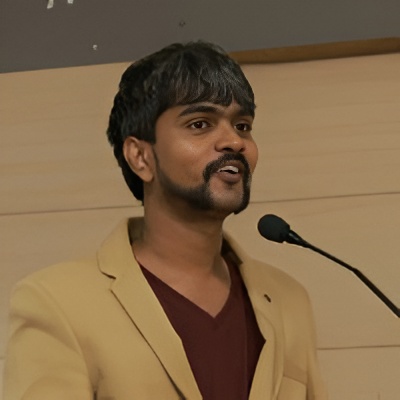
Tarun Ayitam
15 years of designing the scientific method. Alumnus of IISER Pune (Mathematics & Theoretical Computer Science) and TEDx speaker. Tarun encoded 32+ company implementations into PDGMS AI Platform to lower CAC and drive employee ownership.
HERITAGE
Who's been in this room
This programme has been running in different forms since 2011. Fifty participants from six countries have been through it. These are the people whose work and questions shaped what the programme is today.
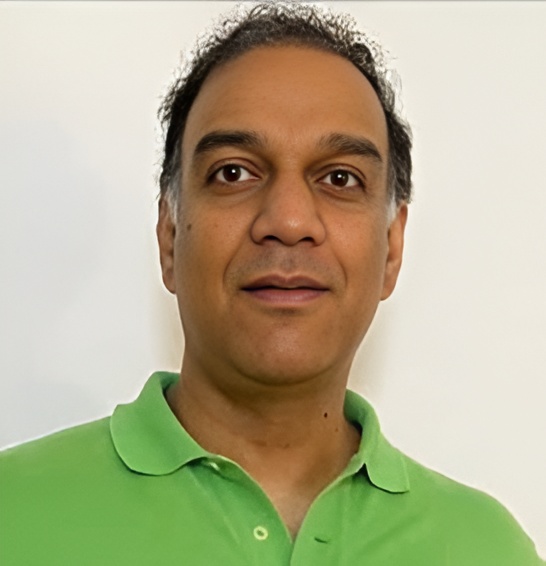
Raghu Seelamsetty
Founder, Escape Velocity
 2017
2017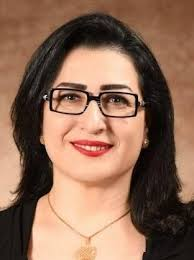
Nastaran Bisheban
CTO, KFC Canada
 2021
2021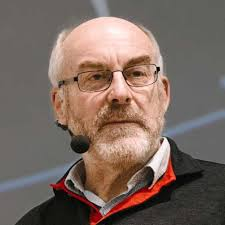
Dave Snowden
Founder & CSO, Cognitive Edge
 2021
2021
Dr. Michael Lissack
President, American Society for Cybernetics
 2021
2021
Abhinav Gupta
AVP Innovation, Broadridge
2023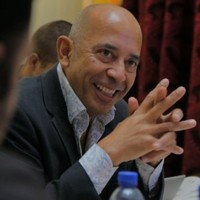
Humberto Schwab
Founder, Socratic Design Academy
 2020
2020
Dr. Matti Itkonen
Cultural Philosopher, University of Jyväskylä
 2021
2021
Kashyap Kompella
Hyderabad Chair, StartupGrind
2017
Jayesh Ranjan
IAS Officer, Govt of Telangana
2017
Dr. David Willows
Director of Advancement, University of Brussels
 2021
2021Designations are as on the date when the participant attended the dialogue.
WHAT IT LOOKS LIKE
The work in action.
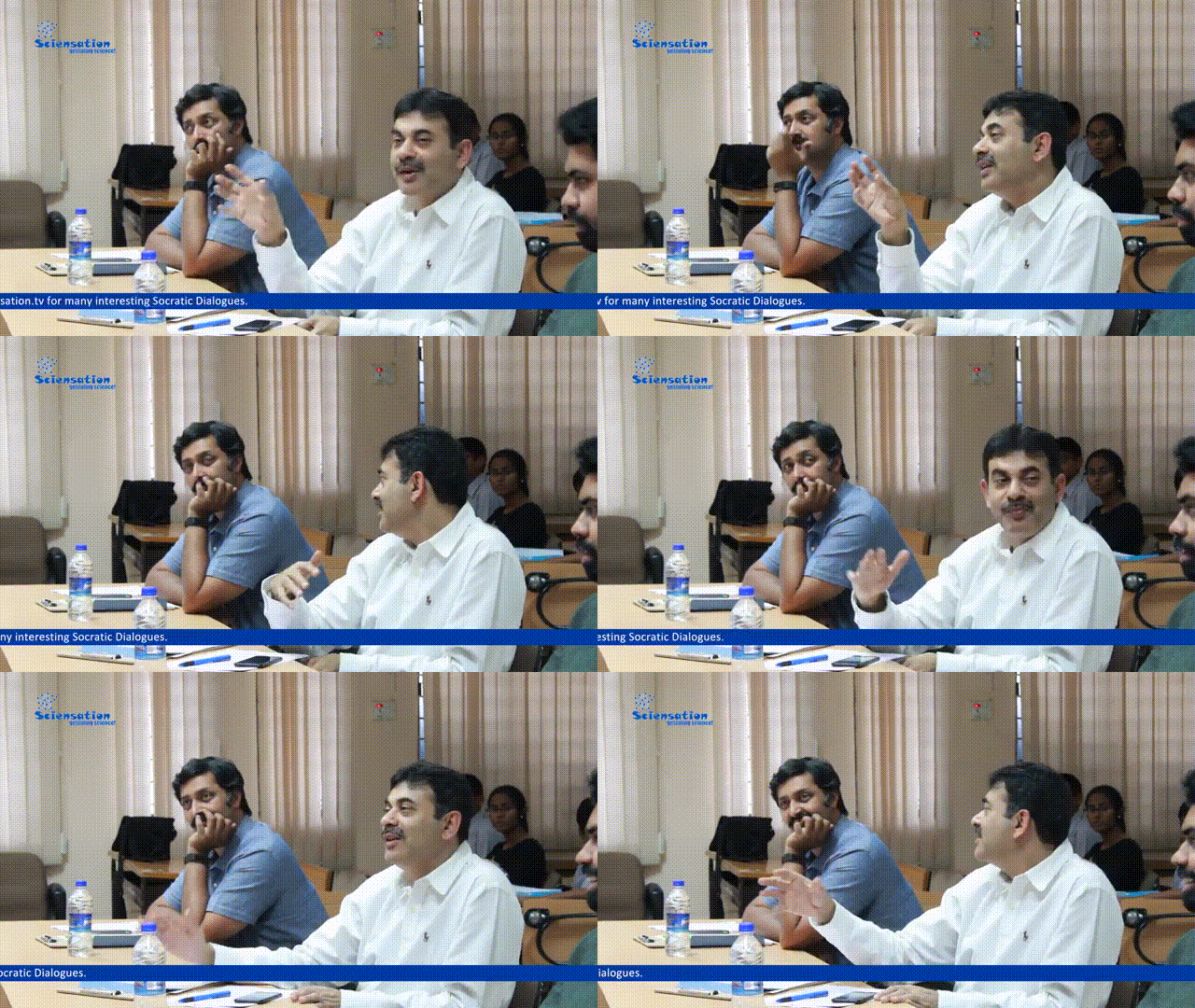
Roundtable
Hack Your MVP
Live session with practitioners and founders.
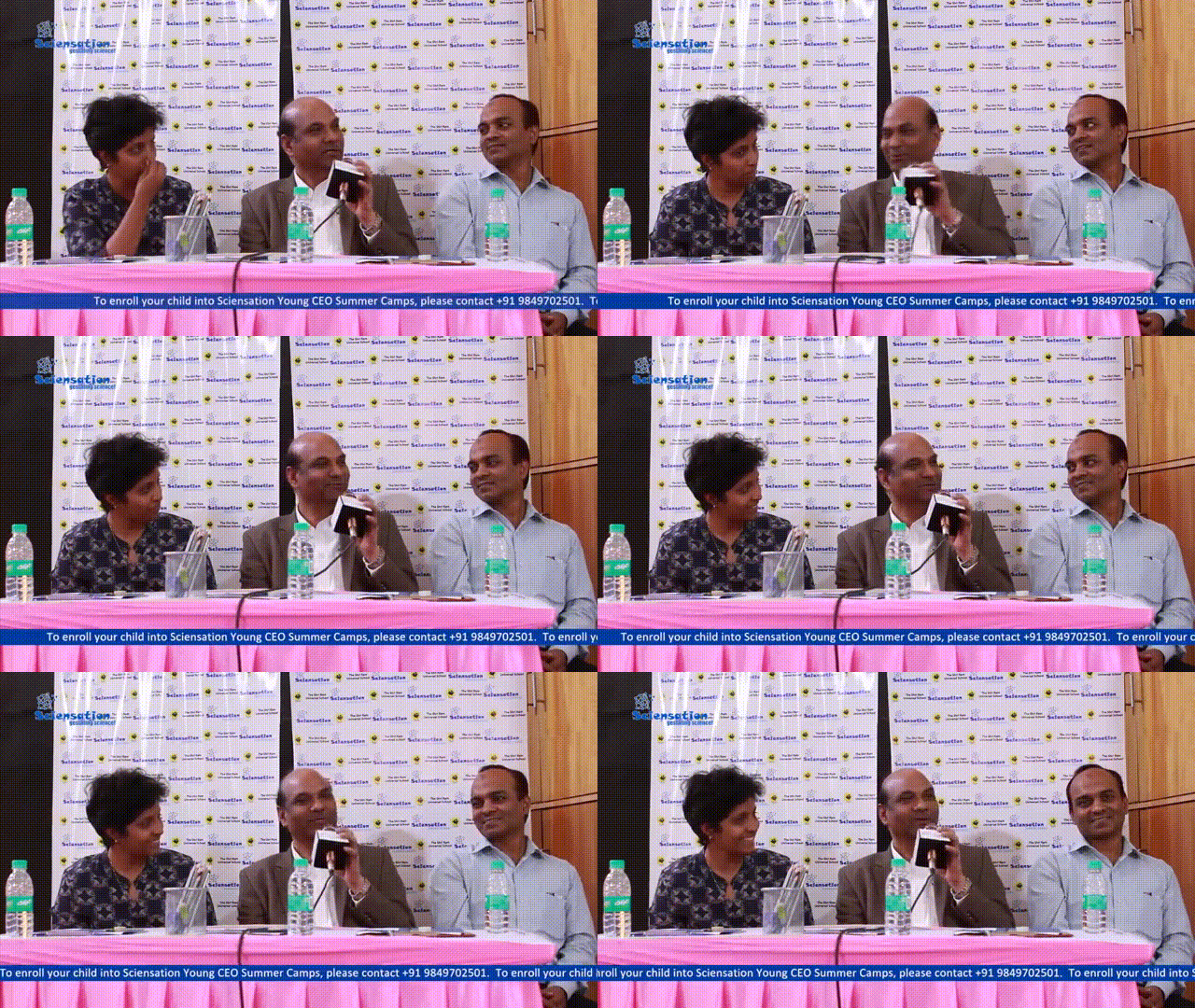
Socratic Dialogue
Darwin Day
Jury-style debate on scientific and business questions.
The Proof

DeepThought helped us in deploying and managing high performance elastic teams. DT runs continuous improvement, which means Project2 is better than Project1 and Project3 is better than Project2
Pharma & Biotech Transformation
The role, plainly
Five years of exposure. Compressed into two.
Two years in this role gives you what most careers give in five: a whole company, every department, systems you designed running on a real floor, and a CEO who reviews your work directly.
The reason it compresses is the same reason it is hard: there is no manager between you and the work. Nobody assigns your day. Nobody breaks problems down for you. The company's leadership has no spare hours, this role exists to give them hours back, not to take more.
Most people can do one of those two. This job needs both, in the same person, with the judgment to know which one a moment calls for.
What happened last month
Three candidates sat in front of a client CEO. None made it.
All three had done the assignment. The strongest had researched the industry for a full week and built RACI charts, escalation chains and a polished deck. Everything they were asked about how to do things, they answered. Then the CEO asked what any of it was for.
What the CEO asked them
0 of 6 opened
Open each one. See what came back.
Questions about how
Questions about what it is for
“All of you are talking about things without understanding what they mean. And that is dangerous.”
The test was never polish. It was: did you internalize it, or are you parroting it? If you reach for AI's words because they sound smarter than yours, that is the one thing that will surface here.
Before you invest the hours
The job, in eleven questions.
Answer these with real events, not intentions. A family business, a shop, a farm, tuition classes, a college fest, a failed startup, all of it counts, if the consequences landed on you. Nobody sees your answers. This is for you.
Can you run yourself?
Nobody here assigns your day. These four tell you if that excites or terrifies you.
Can you produce your own written plan for yesterday? Not describe it, produce it.
Have you ever been handed something completely unfamiliar and asked your questions upfront, in the first conversation, instead of discovering them mid-way?
Has a plan you owned ever collapsed on the day, and can you narrate what you did, hour by hour, without drama?
Have you built or started something nobody asked for, that outlived the week you built it?
Can you carry hard truths?
Escalating early, refusing what isn't yours, owning what nobody saw. The expensive half of the job.
Have you ever told someone senior that something was going wrong, before they found out on their own, when staying quiet was easier?
Have you ever refused work that was not yours to absorb, and paid a social price for it?
Have you ever admitted a mistake that nobody would have discovered?
Do you dig beneath the surface?
The CEO's question that broke three candidates lives here.
When everyone around you believed something, have you checked it yourself and found it false?
Have you ever chased a problem past the first explanation, and then past the second, until you found the real cause?
Have you ever entered a place where you knew nothing, and deliberately spent time understanding it before offering your first opinion?
Has someone senior ever kept hinting at what they wanted instead of saying it, and you decoded it and acted on it correctly?
These questions are the job in miniature. If most of them have real answers from your life, the assignment below will feel like recognition, and we want to read yours. If they don't yet, that is a stage of life, not a verdict, and now you know exactly what to go build. Either way, you leave this page knowing more about yourself than most selection processes will ever tell you.
What is expected from you
"I will talk to them" is not an answer.
Every answer carries three things: a diagnosis with the root cause named, a solution tied to it, and a process broken down to tasks, sub-tasks, owners, and time (WBS).
What we reject
"I will conduct meetings with the stakeholders, understand their problems, and improve the communication between departments." Who? About what? By when? This describes intent, not work.
What we expect
A root cause named and evidenced from the material in front of you, not a symptom restated. Then the fix that follows from it. Then the process, with a WBS deep enough that someone else could run it without you in the room.
You will be cross-examined
Whatever you submit, you defend live, no slides, no notes. Real questions from real interviews for this role:
"What does this business actually exist to deliver?"
"You proposed this system. Walk me through exactly how it works, without reading."
"Do you believe this, or are you just saying it because it sounds nice?"
"Show me your own plan for yesterday."
"What in this document is your thinking, and what came from AI?"
If a section would not survive these questions, cut it before you submit. Fewer claims, each one owned.
Before you start — read this
Your learning map gets a few seconds.
Just like an answer sheet.
Picture an examiner with 300 papers stacked in front of them. Yours gets seconds, not minutes. The marks don’t go to whoever wrote the most. They go to the one answer that is clearly their own. Your hand-drawn learning map is that answer sheet.
You draw it by hand
On paper. No printout.
We glance, like an examiner
Seconds, not minutes.
It earns the marks, or it doesn't
Your thinking, or ChatGPT's.
Here’s the test we actually run
ChatGPT
4 seconds📄 [pasted: this entire assignment page]
Here is your diagram: Problem → build a dashboard → train the team → done.
If that is your diagram too —
where is your thinking?
And ChatGPT will hand you confident, wrong answers. We expect you to argue with it, test the logic, and catch what doesn’t hold. The thinking is the part it cannot do for you.
What ChatGPT gave back
“Problem → build a dashboard →
train the team → done.”
Word for word, what ChatGPT said.
Could be any company, anywhere.
Reads like everyone else’s.
Your own thinking
I asked it back: would a dashboard
actually get used? It wouldn’t —
the last one didn’t.
So I drew what really blocks the work.
Specific to this problem. By hand.
We want to meet you.
Most pages we get are exactly what ChatGPT returns. We can tell in seconds. The few we shortlist did the digging, caught its mistakes, and drew something it never could. Where is the thinking? That is the entire test.
The learning map, what it looks like
Not your solution. What moved in your head.
Minimum 30 nodes, three types, connections drawn and labeled. Hand-drawn on paper, photographed. The sample below is from a different world on purpose, there is nothing to copy.
Something you didn't know before
Believed X → now believe Y. Write both halves
About yourself, or how organizations work
Selection Process
3 parts. One assignment. Everything on this page.
The entire assignment is on this page. No external links. No GitHub repo. Read everything, think deeply, then show us how you think.
Diagnose, Design, Scale
A real company. Three broken systems. Your job: figure out what's actually going on.
Submit Your Work
Two deliverables. Nothing else.
Understand Manufacturing
Nine departments. One product. Every handoff is a place where things can break.
This process is rigorous and most applicants are rejected. Proceed only if challenges fuel you.
Part 1
70%Diagnose, Design, Scale
You're about to read a condensed account of what's happening inside a mid-scale API manufacturing company. The information is messy, sometimes contradictory, and not neatly organized, just like reality. Read everything before answering anything.
One rule before you start, the Question Window: within the first 12 hours, send ALL your questions in a single message on Internshala. The batch is scored; specific questions that surface real gaps score well. After the window, work with what you have and state your assumptions. Questions that dribble in later count against you.
Read every section. Your diagnosis is only as strong as what you noticed in the material.
Meet the Company
What they do, what they've built so far.
The Company
PharmaTech Ingredients Pvt. Ltd.
PharmaTech Ingredients Pvt. Ltd. (name changed) is an API manufacturer with two manufacturing units, 12 departments, and approximately 200 employees. The company has a CEO (Mr. R), a COO (Mr. B), a General Manager (Mr. S), and 12 department heads (HODs) who manage the shop floor. Six months ago, the company brought in two young process improvement specialists, Anil and Karthik, from an external consulting firm. Their mandate: introduce systems, improve departmental efficiency, and drive cultural change to make the organization ready for scale.
What Anil and Karthik Have Built
They've done real work:
Unified Tracker
Replaced fragmented department-level Excel sheets with a single unified tracker. The CEO approved it. All 12 managers adopted it. It's still being followed.
Automated Daily Alerts
Built a pipeline: Excel to formulated dashboard to Power Automate to daily email to CEO and COO. Each department's pending action items, RAG status, sent every morning.
Meeting Discipline
Daily status meetings are happening. MOMs are documented. Action items are tracked.
Software Attempt
Tried to implement a project management tool (similar to Monday.com). Failed. The HODs couldn't adapt. Anil and Karthik pivoted to building everything within Excel, which people already used.
Part 2
Submit Your Work
Two deliverables. Nothing else.
Part 3
Understand Manufacturing
Nine departments. One product. Every handoff is a place where things can break.
Commitment
What we ask. What we invest.
This is a full-time commitment. Proceed only if you can dedicate the required time and energy.
Schedule
9:30 AM – 6:00 PM
Monday – Saturday
Duration
24 months
Full-time fellowship
Compensation
₹25,000–₹45,000/month
Probation (Months 1–6): ₹25,000/month · Post-probation (Months 7–18): ₹35,000/month · Last 6 months (Months 19–24): ₹45,000/month
L&D Investment
₹5,000/month
DT invests in your growth
Location
Atchutapuram (AP) or Hyderabad, your choice
Experience: 0–4 years
Internet
High-speed required
Stable for video calls
Rules of Engagement
AI policy. Per part.
Part 1 & 2: Research & Writing
Use AI tools freely for research, learning, and drafting. Set guardrails against hallucination.
Hand-drawn Diagram
Must be drawn by hand on paper. Not digital, not AI-generated. 30+ nodes: what you learnt, what beliefs changed, what you realized.
All Communication with DT
We want YOUR thinking, not a language model's.
Consent to Proceed
Before starting, you'll reply on Internshala with:
“I understand that:
- The selection process is long, rigorous, and most applicants are not selected.
- I may be rejected even after significant effort.
- I will remain professional in all communication.
- I will not use LLM/AI tools in the chat thread.
- I will complete the assignment within 48 hours.”
FAQs
Common questions. Clear answers.
Open Roles
Pick your path into the DT Fellowship.
Each role has a unique Round 1 assignment. The selection experience (rounds, mentorship, the work) is the same.